John Milton takes a look at the Frisky.
One of the prettier of the small wave (probably more of a ripple) of microcars that hit these shores in the late 1950s was the Frisky, a car whose story had actually started in Egypt after the Second World War. Then Captain Raymond Flower, a British racing driver, was managing director of the Cairo Motor Company, and it was he who had the idea to create a small car that would be built by Egyptians and would be affordable to the mass population.
However, events conspired against him and the 1952 revolution in Egypt saw a regime change and the installation of Gamal Abdel Nasser Hussein as President. In 1956 the Suez Crisis caused worldwide disruption and the expulsion of British citizens from Egypt.
Enjoy more Old Bike Mart reading every month.
Click here to subscribe & save.

However, back in England, Raymond Flower continued to pursue his ‘people’s car’ idea, with the intention it would be aimed at third world countries. But, with petrol rationing caused by the Suez conflict, there was suddenly a growing interest in small, economical vehicles for the home market. Having lost not only his livelihood but his home when forced to leave Egypt, Flower was in no position to move forward with this project on his own.
So, after talking to a number of manufacturers, he found a receptive audience in Henry Meadows Ltd, a renowned engine and gearbox manufacturer in Wolverhampton. Flower, along with Gordon Bedson and Keith Peckmore, was given space at Meadows’ factory to develop the idea as Henry Meadows (Vehicles) Ltd, and the result as ‘The Bug’ prototype which, while it proved impressive in terms of both economy and reliability was, to be blunt, ugly. The job of restyling the car was given to Giovanni Michelotti of Turin, a young designer who would go on to work for Ferrari, Lancia, Maserati and Triumph (where he designed the Stag, Herald and Dolomite).
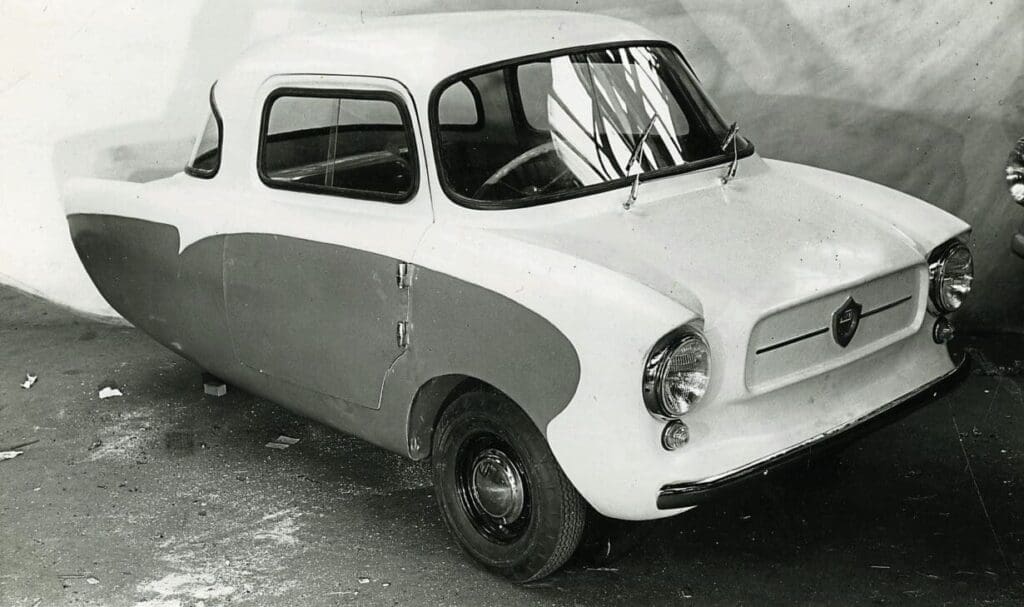
With typical Latin aplomb, Michelotti gave the prototype – now called the Frisky – gull wing doors which wowed the audiences at the Geneva Motor Show in early 1957. Back in Wolverhampton, reality set in; the gull wing doors were fabulous, but fabulously expensive. Instead, the doors and roof were removed and the Frisky entered production as a convertible.
It was intended that two models would be shown at the Earls Court Motor Show in October 1957, the soft-top Frisky Sport and a saloon version with a hard top and suicide doors, both powered by a Villiers 9E engine. In the event, only the Frisky Sport was on display (the Frisky Coupe wouldn’t appear until the following year’s show), but that, once again, met a keen response.
However, it seems that the owners of Meadows, despite initial enthusiasm, began to get cold feet. After the Geneva Motor Show the public response had been tremendous, with the Wolverhampton plant being inundated with telephone calls, letters and visitors, all enquiring about the Frisky. (It was said that the day after the car was unveiled, the meadows factory received 400 letters, another 300 the following day and dozens for days after.) The company considered the car project very much a sideline and now one that was disrupting the main business and, in spite of forecasts that 200 cars could be produced a week with a substantial profit margin, it elected to sell the controlling interest in the vehicle division to Raymond Flower.
But the enquiries didn’t translate into sales, there were problems with the supply of components and increased prices. Flower and his team spotted a potential lifeline when they realised that three-wheeled vehicles were classed as motorcycles and thus incurred far less purchase tax than cars. This saw the development of the hardtop Family Three, £100 cheaper than its four-wheeled sibling and with a higher profit margin.




Things should have gone well from here on in. They did not.
Too much of the construction was outsourced, something which was highlighted when Vickers Armstrong which had agreed to make the mechanical components of the Frisky reneged upon that contract. (Vickers would eventually do the work but much time had been lost.) An order for 100 Frisky Sports from the USA seemed positive – until it was found that American fuel dissolved the lining in the petrol tank and stopped the carburettor working. By August 1958 the company was on the verge of bankruptcy.
Enter Henry Stone of the Marston Group of Companies. Under his Chairmanship, money was raised, suppliers appeased and production resumed. After President Nasser inspected a Frisky Sport, Henry Stone and Raymond Flower invited the Egyptian Minister of Commerce to tour the Frisky factory and he was so pleased with what he saw that he placed an order for 10,000 cars which would be rebadged as the Ramses. This would be built in Egypt and would have a monopoly in the country – no other small car could be either made or imported into Egypt. It would be a goldmine for the Frisky.
And then the British Government refused to issue a licence for parts to be shipped to Egypt. The deal fell apart and, although the Ramses project went ahead, it would be as an NSU Prinz.
From there it was downhill. The company went out of business in the summer of 1959; Raymond Flower severed his connection with Frisky; Bedson and Peckmore went to work for an Australian company (ironically, they would develop the Lightburn ‘Zeta’ that used a Frisky chassis and was based on the Sprint).
In August 1959 a garage owner called CJ Wright bought all the stock, tooling, jigs, rights to manufacture and the Frisky name from the Official Receiver. Production recommenced as Frisky Cars (1959) Ltd with two three-wheelers, the Frisky Family Three Mk2 and the Frisky Prince. But by now the BMC Mini was conquering the small car market. The Prince in particular was not a success and just a few months later Wright sold the firm to Petbow Ltd in Sandwich, Kent. Frisky Family Three body shells were moved to Kent in 1961 where they mouldered away in a yard. For a few years, Petbow employees would provide a kit or even assemble a car for the occasional customer, but even this ceased by 1966.
Of all the various microcars that came and went during this period, the story of the Frisky is perhaps the saddest of all. It had so many opportunities that were stolen away from it, from supplier intransigence to American fuel to bureaucratic nightmares. Today the Frisky engenders passion among its enthusiasts and, according to John Meadows, grandson of Henry Meadows and who has run The Frisky Register for almost 50 years, there are around 75 surviving Friskys.
Original article appeared in Old Bike Mart. To subscribe, click here: https://www.classicmagazines.co.uk/old-bike-mart